
Comparison of welding effects of lasers with different core diameters
Laser processing of metal materials is mainly thermal processing based on the photothermal effect. When the laser irradiates the surface of the material, the surface area of the material will undergo various changes under different power densities. These changes include increased surface temperature, melting, vaporization, keyhole formation, and photoplasma generation. Moreover, the change of the physical state of the material surface region greatly affects the material's absorption of laser light. Generally speaking, the higher the temperature, the higher the material's absorption rate of laser light. With the increase of power density and action time, the metal material will undergo the following physical state changes, as shown in Figure 1 [1].

There are two cores of laser welding: heat transfer and heat conduction. Heat transfer is related to heat source, power density and line energy; Airflow to fine-tune. In the welding process, the heat source, power density, and line energy are mainly adjusted. The process parameters involved include: the selection of laser core diameter, power, speed, and defocus amount. Considering that this article mainly focuses on lasers with different core diameters and mainly involves different power densities, Figure 2 shows the simple calculation formula of power density:
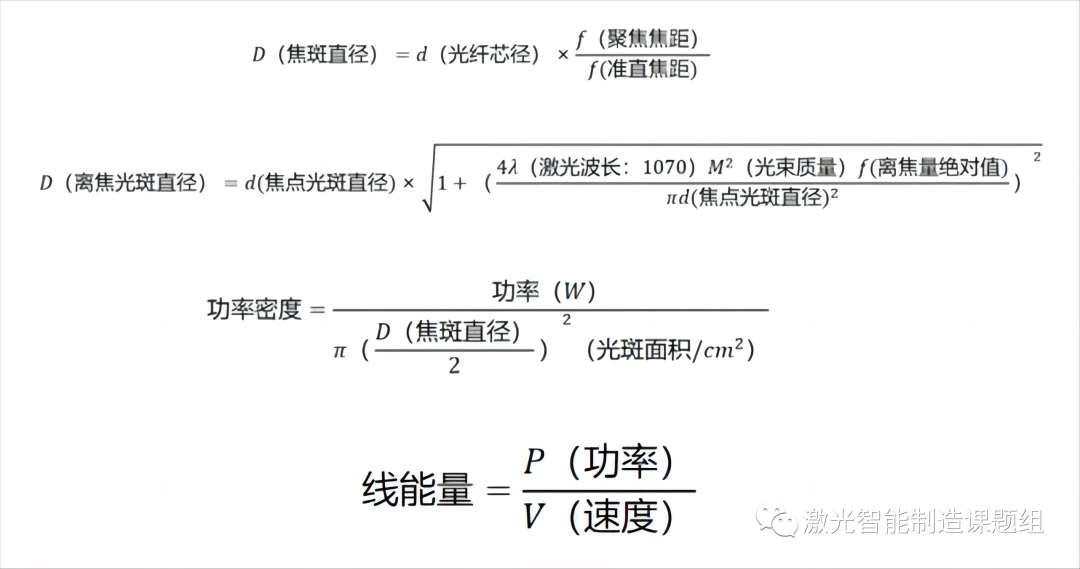
There are two main types of laser welding according to the absorption rate of the welding process, one is heat conduction welding (depth-width ratio <1, laser absorption rate of red light is within 20%, and different wavelengths are different), and the other is deep penetration welding (Aspect ratio > 1, the absorption rate is greater than the absorption rate of the molten pool of the material, more than 60%, mainly due to the multiple reflection and absorption of the laser in the keyhole).
Laser heat conduction welding:
Different laser irradiance will cause different changes in the state of the material, which is reflected in the welding process as two typical welding modes: laser heat conduction welding and laser deep penetration welding. The heat transfer process, weld formation mechanism, process characteristics and application range of the two are very different.
Laser heat conduction welding mode:

During heat conduction welding, the laser irradiance irradiated on the surface of the workpiece is in the range of 10E4~10E6W/cm, and the laser energy is absorbed by the thin layer of 10~100m on the surface. The laser energy on the surface is transmitted to the interior of the material by heat conduction, and the laser cannot be directly touched. After a certain period of laser irradiation, the surface reaches melting, and this melting isotherm propagates deep into the material, and the surface temperature continues to rise. But the highest can only reach the boiling point of the material, no matter how high the temperature is, the material will vaporize and form pits, the stable heat conduction welding process will be destroyed, the molten pool will oscillate, and the material will be burned. Generally, heat conduction welding is mostly used in thin plates. In this case Need to put an end to it. With the relative movement of the laser beam and the workpiece, a shallow and wide weld seam is formed, as shown in Figure 3. The depth-to-width ratio of the weld seam is small, and the width of the weld seam is generally more than twice the penetration depth. The figure below shows the cross-sectional appearance of a typical laser heat conduction welding seam, and the shape of the weld seam is approximately hemispherical.

Comparison of different core diameter lasers:
(1) The speed of the experiment is 150mm/s, the focus position is welded, the material is 1 series aluminum, and the thickness is 2mm;
(2) The larger the core diameter, the larger the fusion width, the larger the heat-affected zone, and the smaller the unit power density. When the core diameter exceeds 200um, it is not easy to achieve penetration depth on high-reaction alloys such as aluminum and copper, and requires higher Power can achieve deep penetration welding;
(3) The small core diameter laser has high power density, can quickly punch keyholes on the surface of the material with high energy, and has a small heat-affected zone, but at the same time the surface of the weld is rough, the probability of keyhole collapse is high during low-speed welding, and the keyhole is closed during the welding cycle Long cycle, easy to produce defects, pores and other defects, suitable for high-speed processing or processing with swing track;
(4) Large-diameter lasers are more suitable for laser surface remelting, cladding, annealing and other processes due to their large spot and more dispersed energy.
High reflective materials: aluminum, copper, stainless steel, nickel, molybdenum, etc.;
(1) High-reflective materials need to choose a small-diameter laser. Using a high-power-density laser beam to quickly heat the material to a liquefied or vaporized state, improve the laser absorption rate of the material, and achieve efficient and fast processing. It is easy to choose a laser with a large core diameter. Lead to high reflection, lead to virtual welding, and even burn out the laser;
Crack-sensitive materials: nickel, nickel-plated copper, aluminum, stainless steel, titanium alloy, etc.
(2) This kind of material generally requires strict control of the heat-affected zone and requires a small molten pool. It is more appropriate to choose a small-diameter laser;
High-speed laser processing:
(3) Deep penetration welding requires high-speed laser processing, and it is necessary to select a laser with high energy density to ensure that the line energy is sufficient to melt the material at high speed, especially for lap welding, penetration welding, and other small cores that require high penetration depth. Radial lasers are more suitable.

Advantages and applications of large core lasers (>100um):
Large core diameter and large spot, large heat coverage area, wide action surface, and only achieve micro-melting on the surface of the material, very suitable for applications in laser cladding, laser remelting, laser annealing, laser hardening, etc. In these areas, a large spot means higher productivity and lower defects (heat conduction soldering is almost defect-free).
In terms of welding, the large spot is mainly used for composite welding, which is used for compounding with small core diameter laser: the large spot makes the surface of the material melt slightly, transforming from solid to liquid, which greatly improves the absorption rate of the material to the laser, and then uses a small core In this process, due to the preheating of the large spot, post-processing, and the large temperature gradient given to the molten pool, the material is not prone to crack defects caused by rapid heating and rapid cooling. It can make the appearance of the weld smoother, and at the same time achieve lower spatter than the single laser solution.


