
Optimization parameter results and analysis
1. Comparison of Macroscopic Cleaning Conditions
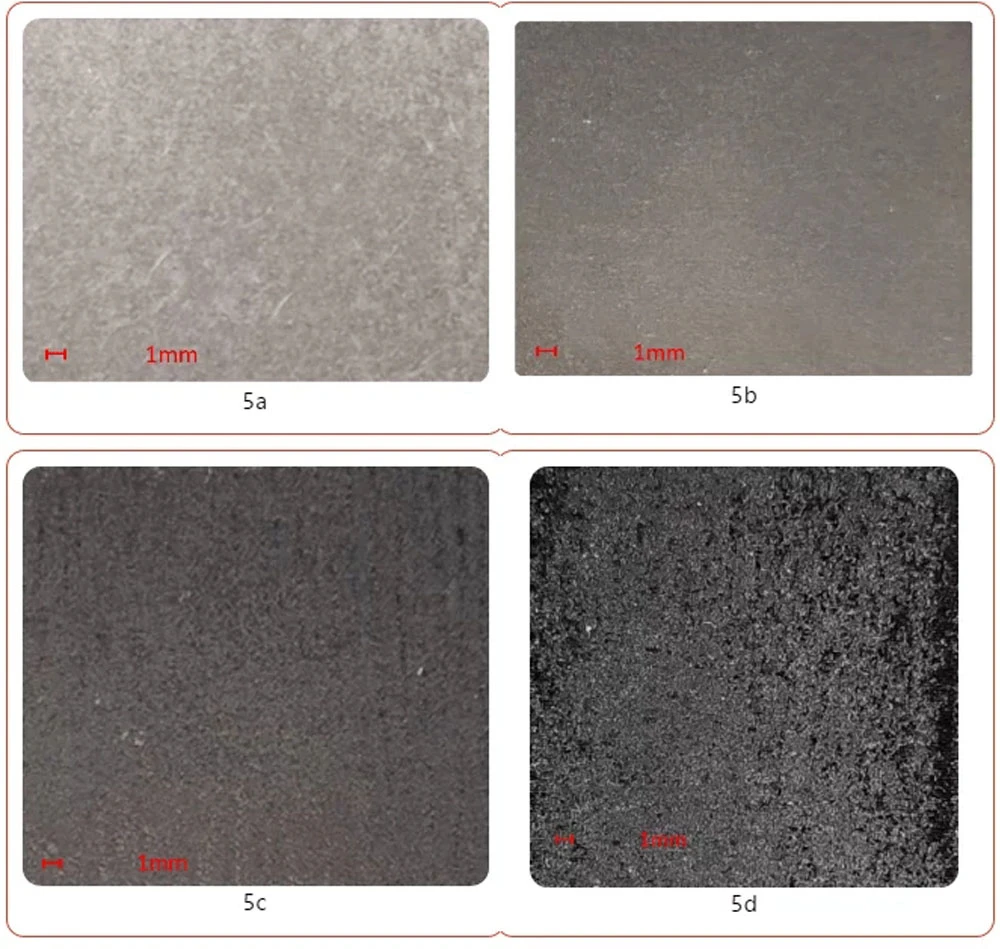
The results of the optimal parameters for cleaning the paint layer on the aluminum alloy surface with pulsed light are shown in Figure 5a, and the results of the optimal parameters for cleaning the paint layer on the aluminum alloy surface with continuous light are shown in Figure 5b. After cleaning with pulsed light, the paint layer on the surface of the sample is completely removed, the surface of the sample appears metallic white, and there is almost no damage to the substrate of the sample. After cleaning with continuous light, the paint layer on the surface of the sample was completely removed, but the surface of the sample was gray-black, and the substrate of the sample also showed micro-melting. Therefore, the use of continuous light is more likely to cause damage to the substrate than pulsed light.
The results of the optimal parameters for cleaning the paint layer on the carbon steel surface with pulsed light are shown in Figure 5c, and the results of the optimal parameters for cleaning the paint layer on the carbon steel surface with continuous light are shown in Figure 5d. After cleaning with pulsed light, the paint layer on the surface of the sample is completely removed, the surface of the sample appears gray-black, and the damage to the substrate of the sample is small. After cleaning with continuous light, the paint layer on the surface of the sample is also completely removed, but the surface of the sample is dark black, and it can be seen intuitively that there is a large remelting phenomenon on the surface of the sample. Therefore, the use of continuous light is more likely to cause damage to the substrate than pulsed light.
2. Comparison of Microscopic Morphology
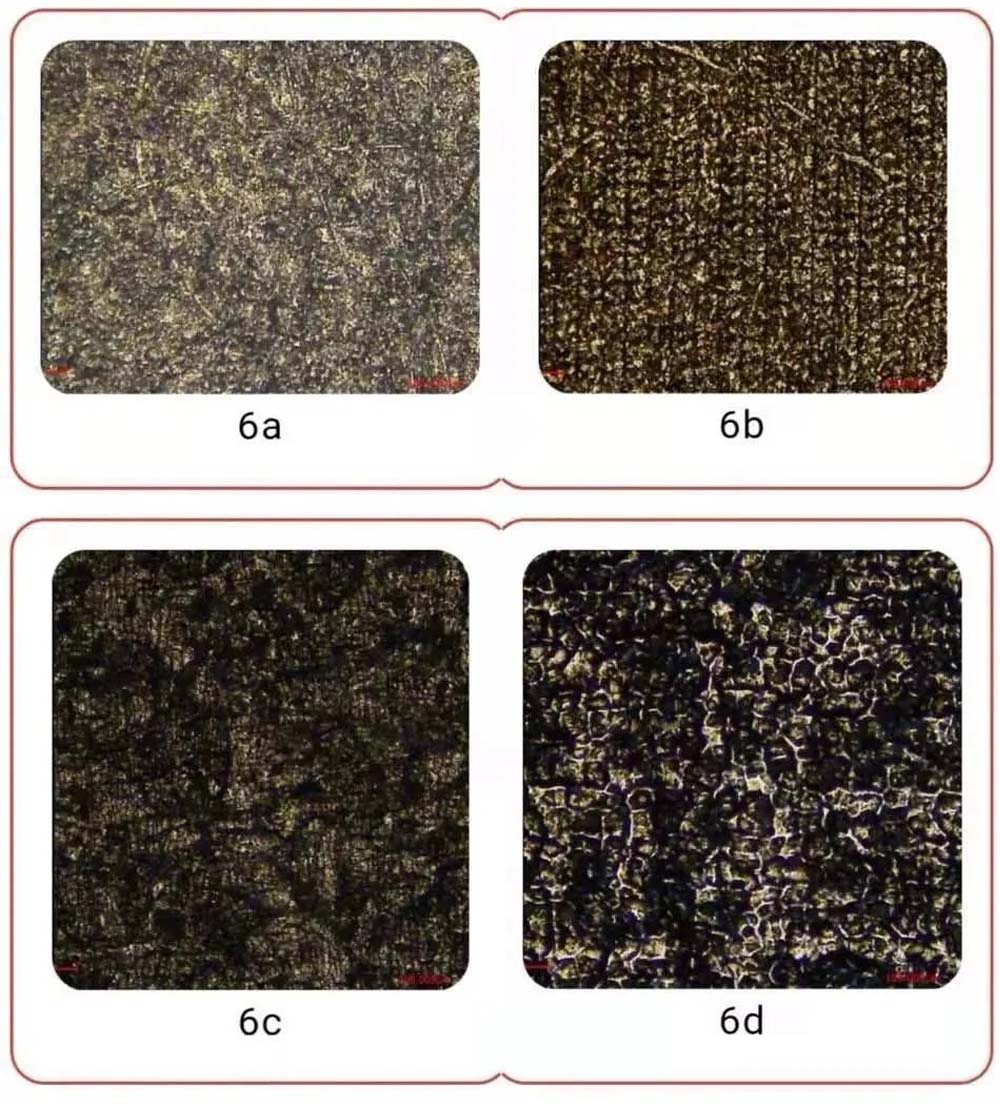
From Figure 6(a), it can be seen that after cleaning the paint layer on the surface of the aluminum alloy with pulsed light, the paint on the surface of the sample has been completely removed, and the surface of the sample has little damage and no laser lines. While using continuous light to clean the sample surface, the paint is also completely removed as shown in Figure 6(b), but serious remelting and laser lines appear on the surface of the sample.
From Figure 6(c), it can be seen that after cleaning the paint layer on the surface of carbon steel with pulsed light, the paint on the surface of the sample has been completely removed, and the surface of the sample is relatively smooth after cleaning with little damage. The surface of the sample is cleaned with continuous light, as shown in Figure 6(d), and the paint is completely removed, but the surface of the sample has a serious remelting phenomenon, and the surface of the sample is uneven.
3. Comparison of material surface roughness
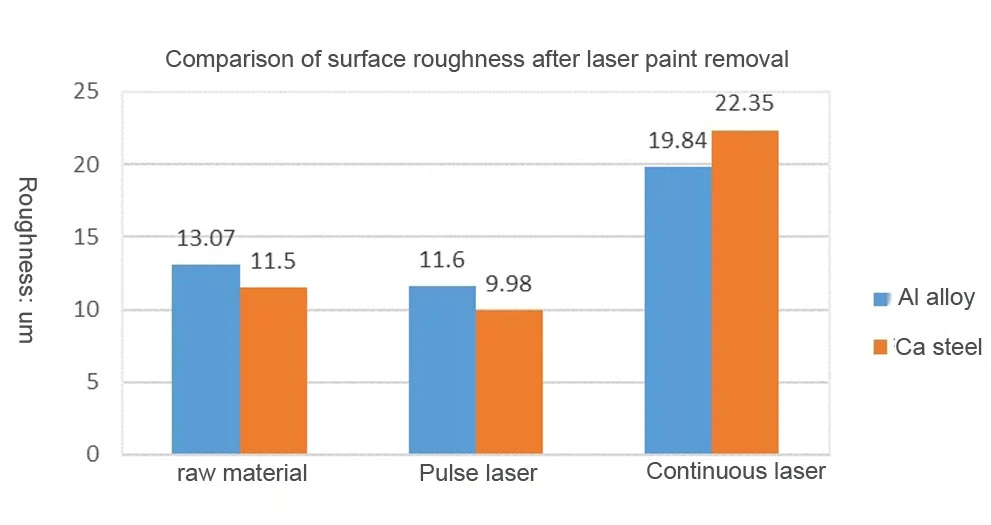
Figure 7 is a comparison chart of surface roughness after laser paint removal. It can be seen from Figure 7 that after laser cleaning the paint layer on the aluminum alloy surface, the pulsed light has less damage to the surface of the sample, so the surface roughness of the sample after cleaning is close to that of the original material. After cleaning with continuous light, the damage to the surface of the sample is greater, so the surface roughness of the sample after cleaning is 1.5 times the roughness value of the original material, and 1.7 times the surface roughness after pulsed light cleaning.
After laser cleaning the paint layer on the surface of carbon steel, the pulsed light will cause less damage to the surface of the sample, so the surface roughness of the sample after cleaning is close to or even lower than that of the original material. After cleaning with continuous light, the damage to the surface of the sample is greater, so the surface roughness of the sample after cleaning is 1.5 times the roughness value of the original material, and 1.7 times the surface roughness after pulsed light cleaning.
4. Cleaning efficiency comparison
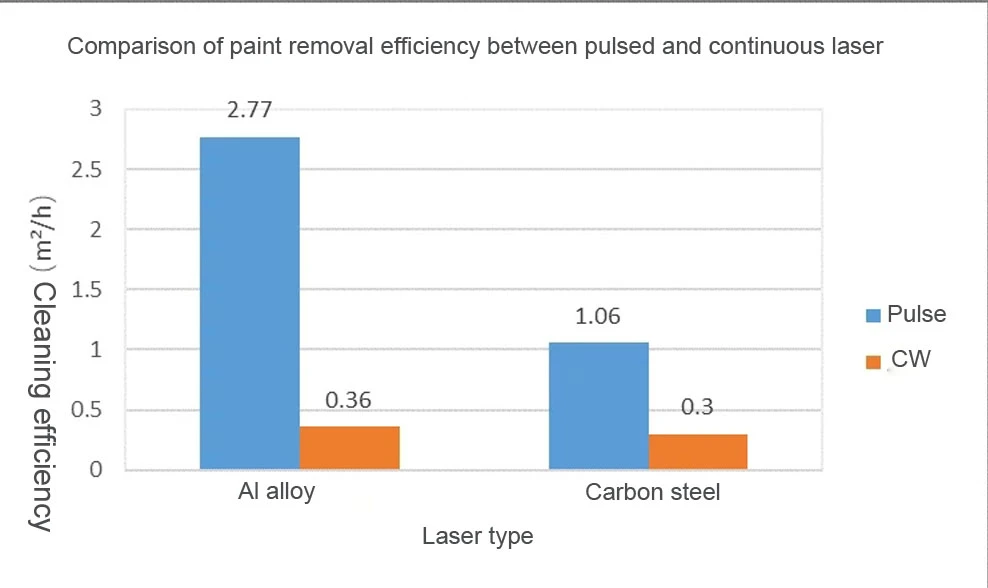
In terms of paint removal on aluminum alloy surfaces, the paint removal efficiency using pulsed light is much higher than that of continuous light, which is 7.7 times that of continuous light. The cleaning efficiency of pulsed light is 2.77m²/h, while that of continuous light is 0.36m²/h.
In terms of paint removal on carbon steel surfaces, the paint removal efficiency using pulsed light is also higher than that of continuous light, which is 3.5 times that of continuous light. The cleaning efficiency of pulsed light is 1.06m²/h, while that of continuous light is 0.3m²/h.
4. Conclusion
Tests have shown that both continuous lasers and pulsed lasers can remove the paint on the surface of the material to achieve the effect of cleaning.
Under the same power conditions, the cleaning efficiency of pulsed lasers is much higher than that of continuous lasers. At the same time, pulsed lasers can better control heat input to prevent excessive temperature of the substrate or micro-melting.
Continuous lasers have an advantage in price, and the gap in efficiency with pulsed lasers can be made up by using high-power lasers, but high-power continuous light has greater heat input, and the damage to the substrate will also increase. Therefore, there is a fundamental difference between the two in application scenarios. For applications with high precision, strict control of the temperature rise of the substrate, and non-destructive substrates, such as molds, pulsed lasers should be selected. For some large steel structures, pipelines, etc., due to the large volume and fast heat dissipation, the requirements for substrate damage are not high, and continuous lasers can be selected.


