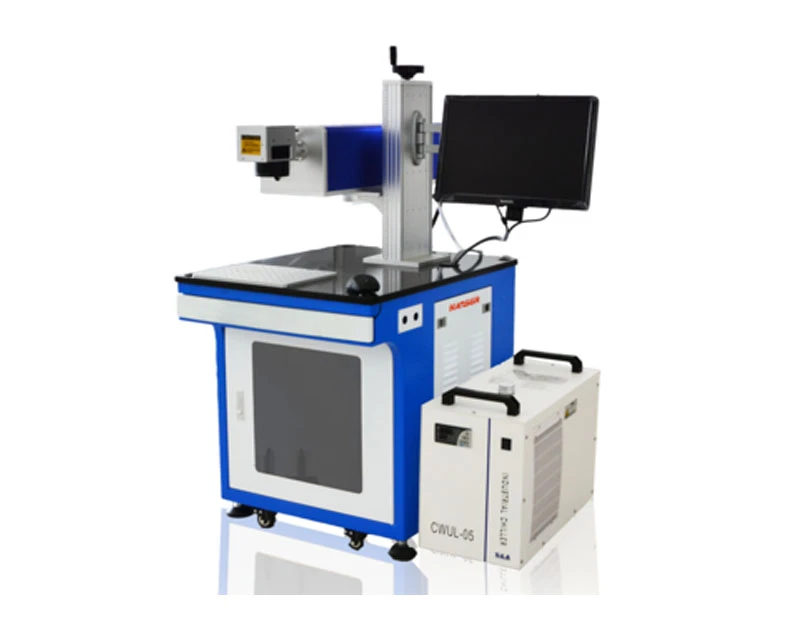
UV laser marking displays:
UV lasers advantages
1. Short laser wavelength
UV lasers have short wavelength (355 nm), suitable for micro-machining, cutting, and engraving delicate materials with minimal heat-affected zones
2. Cold Ablation Process
UV lasers often use a "cold ablation" process, where material is removed layer by layer without significant heat transfer. This prevents melting or warping, making it ideal for high-precision applications.
3. Non-Contact Processing
UV laser machining is a non-contact process, meaning there is no physical tool wear or contamination, no damage to the raw materials.
4. Suitable for mirco-machining
UV lasers are widely used in micro-machining applications, such as creating tiny holes, intricate patterns, or fine features in electronics, medical devices, and optical components.
5. High Repetition Rates
UV lasers can operate at high repetition rates, enabling fast processing speeds while maintaining precision.
6. Compatibility with Sensitive Materials
UV lasers are ideal for processing materials that are sensitive to heat or mechanical stress, such as thin films, flexible circuits, and organic materials.
Versatility in Material Processing
UV lasers can process a wide variety of materials, including:
| 1. Plastics and polymers (e.g., PTFE, polyimide) | ||||
| 2. Glass and ceramics | ||||
| 3. Metals (e.g., copper, gold, aluminum) | ||||
| 4. Semiconductors (e.g., silicon) | ||||
| 5. Biological materials (e.g., tissue, for medical applications) |
industry applications

electronics
PCB drilling, wafer dicing, and electronic devices marking (phone, computer)
Medical
We can provide one-stop solutions for automated testing,sorting,and precision test fixtures in conjunction with package-level system products.

Automotive
Precision cutting and marking of components.

Aerospace
Micro-machining of lightweight materials.
UV lasers-marking samples


UV laser machine displays: