
There are two types of laser cutting technology: the first is pulsed laser for metal materials, and the second is continuous laser for non-metal materials. The latter is an important application field of laser cutting technology.
Several key technologies of laser cutting machine are integrated technology of light, machine and electricity. In the laser cutting machine, the parameters of the laser beam, the performance and accuracy of the machine and the numerical control system all directly affect the efficiency and quality of the laser cutting. Especially for parts with high cutting accuracy or large thickness, the following key technologies must be mastered and solved:
Focus position control technology
One of the advantages of laser cutting is the high energy density of the beam, generally 10W/cm2. Since the energy density is inversely proportional to the area, the focal spot diameter is as small as possible to produce a narrow slit; at the same time, the focal spot diameter is also proportional to the focal depth of the lens. The smaller the focal depth of the focusing lens, the smaller the focal spot diameter. However, there are splashes in cutting, and the lens is too close to the workpiece to damage the lens. Therefore, the focal length of 5"~7.5" (127~190mm) is widely used in general high-power CO2 laser cutting machine industrial applications. The actual focal spot diameter is between 0.1~0.4mm. For high-quality cutting, the effective focal depth is also related to the lens diameter and the material being cut. For example, cutting carbon steel with a 5" lens, the focal depth is within +2% of the focal length, which is about 5mm. Therefore, it is very important to control the position of the focal point relative to the surface of the material to be cut. Taking into account factors such as cutting quality and cutting speed, the principle is The top 6mm metal material, the focus is on the surface; the 6mm carbon steel, the focus is above the surface; the 6mm stainless steel, the focus is below the surface. The specific dimensions are determined by experiments.
There are three easy ways to determine the focal position in industrial production:
(1) Printing method: The cutting head is moved from top to bottom, and the laser beam is printed on the plastic plate, and the spot with the smallest printing diameter is the focus.
(2) Inclined plate method: Use a plastic plate placed obliquely at an angle to the vertical axis to pull it horizontally to find the smallest point of the laser beam as the focus.
(3) Blue spark method: remove the nozzle, blow the air, hit the pulse laser on the stainless steel plate, make the cutting head move from top to bottom, until the largest blue spark is the focus.
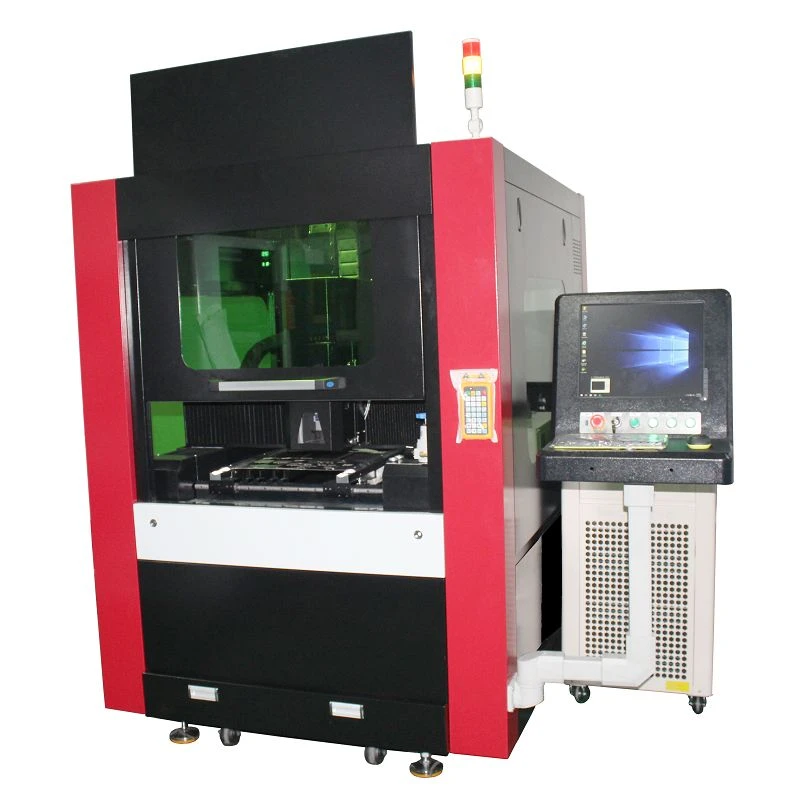
For the cutting machine of the flying light path, due to the beam divergence angle, the optical path length of the near end and the far end of the cutting are different, and the beam size before focusing is different. The larger the diameter of the incident beam, the smaller the diameter of the focal spot. In order to reduce the change of the focal spot size caused by the change of the beam size before focusing, the manufacturers of laser cutting systems at home and abroad provide some special devices for users to choose:
(1) Parallel light pipe. This is a commonly used method, which is to add a collimator to the output end of the CO2 laser for beam expansion. After the beam expands, the diameter of the beam becomes larger and the divergence angle becomes smaller, so that the proximal and distal ends of the cutting work range The beam size before focusing is nearly the same.
(2) Add an independent lower axis of the moving lens to the cutting head, which is two independent parts from the Z axis that controls the distance between the nozzle and the surface of the material (stand off). When the machine tool table moves or the optical axis moves, the beam moves from the proximal end to the distal F axis at the same time, so that the beam spot diameter remains the same in the entire processing area after the beam is focused. As shown in Figure 2.
(3) Control the water pressure of the focusing lens (usually a metal reflective focusing system). If the beam size before focusing becomes smaller and the focal spot diameter becomes larger, the water pressure is automatically controlled to change the focus curvature to make the focal spot diameter smaller.
(4) Add x and y direction compensation optical path system on the flying optical path cutting machine. That is, when the optical path at the distal end of the cutting is increased, the compensation optical path is shortened; on the contrary, when the optical path at the proximal end of the cutting is decreased, the compensation optical path is increased to keep the optical path length consistent.


