


Table Type UV Laser Marking Machine

Table Type UV Laser Marking Machine suppliers

Table Type UV Laser Marking Machine factory

Table Type UV Laser Marking Machine best

Table Type UV Laser Marking Machine high quality
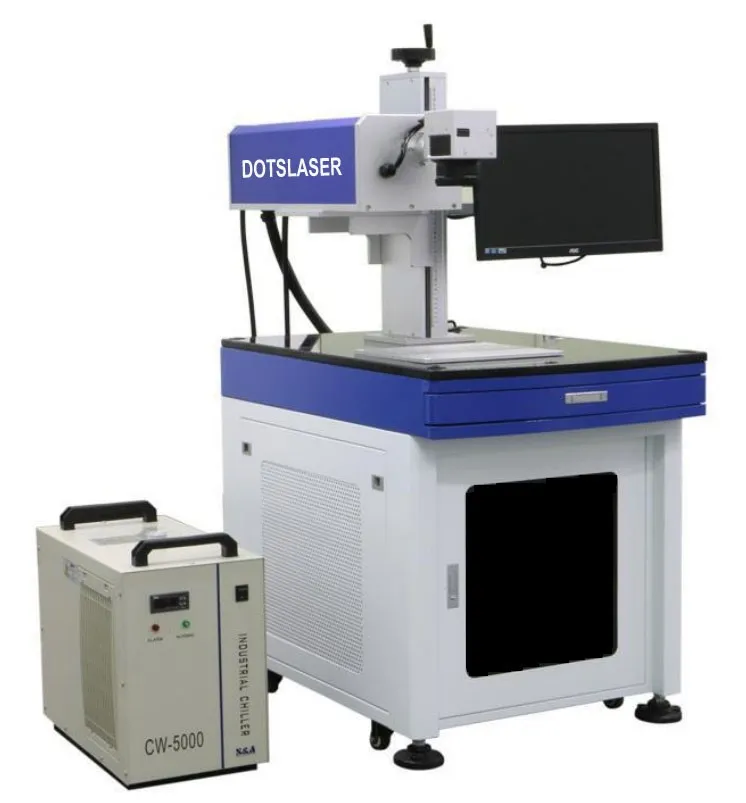
Table Type UV Laser Marking Machine price

Table Type UV Laser Marking Machine factory

Table Type UV Laser Marking Machine high quality
Table Type UV Laser Marking Machine
Table Type UV Laser Marking Machine
1. Overview
The Table Type UV Laser Marking Machine represents a leap forward in precision marking technology. Utilizing a 355nm ultraviolet (UV) laser source, this system is specifically engineered for "cold processing." Unlike traditional infrared (1064nm) or CO2 (10600nm) lasers that rely on thermal heating, the UV laser breaks molecular bonds via photochemical reaction. This results in minimal heat input, making it the definitive solution for marking heat-sensitive materials without causing burns, deformations, or surface damage -1-3.
This desktop configuration is designed for bench-top use, offering a compact footprint, a split controller for flexible placement, and robust industrial components suitable for 24/7 operation.
2. Key Technical Specifications
Below are aggregated specifications based on industry standard models
Parameter Standard Value / Range
Laser Type Q-switched Solid State UV Laser (Diode Pumped)
Wavelength 355 nm (±5%)
Laser Power Options 3W, 5W, 10W, 15W (Upgradeable options available)
Pulse Width < 15 – 18 ns
Frequency Range 20 kHz – 300 kHz
Cooling System Water-cooling (Standard for >3W) / Air-cooling (Select 3W models)
Marking Area (Standard) 110 x 110 mm (Optional: 150x150, 200x200, 300x300 mm)
Max Marking Speed Up to 15,000 mm/s (Typically 7,000 – 15,000 mm/s depending on galvo)
Min Line Width 0.01 mm – 0.02 mm (10–20 µm)
Min Character Size 0.1 mm – 0.2 mm
Z-axis Adjustment Manual / Motorized (Up to 500mm travel)
Laser Source Lifespan > 20,000 hours (Maintenance-free)

3. Core Technology & Physics
The "Cold Marking" Advantage
The fundamental difference of a UV laser lies in its photon energy. At 355nm, the wavelength is shorter and carries higher energy than visible or infrared light. This allows the laser to directly break the molecular bonds of the material (photochemical ablation) rather than heating it until it melts or evaporates (photothermal).
Heat Affected Zone (HAZ): Narrower pulse width (nanosecond range) ensures the surrounding area remains at ambient temperature.
Absorption Rate: Most materials, including metals and glass, have a significantly higher absorption rate for UV light than for IR light, allowing for effective marking at lower power levels
4. Material Compatibility & Applications
Due to its cold processing nature and ultra-fine spot size, this machine is the preferred tool for high-end markets where surface finish and precision are critical -3-10.
Metals
Materials: Stainless steel, Gold, Silver, Aluminum (anodized), Copper, Titanium.
Applications: High-contrast black annealing on medical scalpels, jewelry engraving, automotive VIN plates, watch dials.
Plastics & Polymers
Materials: ABS, PVC, Polycarbonate (PC), PET, Polyimide, PMMA (Acrylic).
Applications: PCB board serialization, membrane switch etching, wire and cable marking, cosmetic bottles, medical device syringes. UV marking produces a clean, sharp "anti-sweat" mark on plastic without the sticky residue or bubbling often seen with fiber lasers -3-8.
Glass & Crystals
Materials: Wine glasses, smartphone screens, laboratory beakers, crystal awards.
Applications: Unlike CO2 lasers which create micro-cracks, UV lasers produce smooth, frosted logos on glass without shattering the structural integrity due to the lack of thermal shock.
Other Materials
Materials: Ceramics, Rubber (silicone keypads), Wood, Leather.
Applications: High-end packaging, automated part tracking, silicone buttons

5. Mechanical & Structural Design
Table Type Configuration
The system consists of two primary units:
Laser Head & Galvo Scanner: Mounted on a rigid column (stand) with a base table. The head moves vertically via a manual or motorized Z-axis lift to adjust focal length.
Split Controller Cabinet: Houses the laser source and control electronics. This "split" design isolates the sensitive laser engine from vibration and heat generated by the marking head, ensuring stability and allowing the controller to be placed in a separate cabinet or electrical panel -1.
Scanning System
Equipped with high-speed digital galvanometers (Galvo scanners). The mirrors move with high acceleration to trace vectors (DXF, AI, PLT) or raster images (JPG, BMP) at speeds exceeding 7,000 mm/s.
Optional Rotary Axis
The system supports a 3-axis / 4-axis configuration by adding a rotary chuck (Rotary Axis). This allows for 360-degree circumferential marking of cylindrical objects such as pipes, bottles, or tubes
6. Operational & Safety Features
User Software: Typically operates on EZCAD or Lenmark software, supporting true-type fonts, barcodes, QR codes, and serial number auto-generation (variable text) -6-9.
Focusing Assistance: Equipped with dual red light pointers (visible 650nm) to help the operator visually locate the exact focal plane before firing the invisible 355nm UV beam -3-9.
Safety Enclosure: Most table-type models come with a safety shield or a full Class 1 enclosure cover. This shield blocks the harmful UV radiation and includes an interlock switch that automatically stops the laser if the door is opened -1-9.
Environment: Designed to operate in temperatures between 0°C and 40°C, non-condensing.
7. Advantages vs. Alternative Laser Types
Feature UV Laser (355nm) Fiber Laser (1064nm) CO2 Laser (10600nm)
Marking Type Photochemical (Cold) Photothermal (Hot) Photothermal (Hot)
Heat Affected Zone Very Low / None Moderate High
Plastic Marking Excellent (No melt) Poor (Melting/Deformation) Good (Thick materials)
Glass Marking Excellent (Smooth) Poor (Micro-cracks) Fair (Requires special coating)
Metal Marking Good (High contrast/Bare metal) Excellent (Deep engraving) No (Reflective)
Maintenance Low (Sealed source) Very Low (Diode life) High (Mirrors/Refill)
8. Power & Service Requirements
Electrical: 110V / 220V (Single Phase), 50/60 Hz. Power consumption ranges from 600W to 2.0 kW depending on laser power and chiller size.
Consumables: Zero consumables. The system is virtually maintenance-free beyond cleaning the protective window and replacing distilled water in the chiller annually.
Footprint: Approx. 800mm (W) x 700mm (D) x 1400mm (H). (Controller cabinet adds additional ~400mm width).
Previous
No InformationYou Might Also Like


Send Inquiry